
Landscaping in 2026: Why Manual Operations Are Holding Businesses Back
A New Era for Landscaping Businesses
Landscaping used to be a seasonal business. Mow in the summer, rake in the fall, plow in the winter-then wait for the next season.
That’s no longer the reality.
Today’s landscaping companies operate year-round, offering irrigation, tree care, snow removal, hardscaping and landscape design-often for the same customers across every season. Homeowners expect quick responses, while commercial clients expect accurate contracts, predictable invoices and reliable service.
Demand continues to grow and so does the pressure to operate faster, more efficiently and with fewer mistakes.
Yet many landscaping businesses are still relying on notebooks, spreadsheets and endless phone calls to manage daily operations-the same methods they used a decade ago.
Why Growth Creates Operational Challenges
A one-truck operation can survive with memory and a paper calendar. A five-truck operation cannot.
As soon as a business adds another crew, expands into a new service area, or signs recurring maintenance contracts, coordination becomes much more difficult.
Who’s scheduled to visit which property today? Was last month’s invoice actually sent? Which contracts are about to expire?
These aren’t problems caused by a lack of effort-they’re coordination challenges that naturally appear as a business grows.
The Hidden Impact of Manual Workflows
Manual systems rarely fail overnight. Instead, they create small mistakes that slowly build into larger operational problems.
A missed appointment becomes an unhappy customer.
A delayed invoice affects cash flow.
A crew sent to the wrong property wastes valuable time and fuel.
Common signs of inefficient manual processes include:
- Double-booked crews
- Invoices sent days or weeks late
- Difficulty tracking contract renewals
- Completed jobs without photos or customer signatures
- Customer information stored across multiple systems
- Limited visibility into field crews throughout the day
These issues don’t happen because employees aren’t working hard. They happen because manual processes simply weren’t designed to support a growing business.
What High-Performing Landscaping Companies Do Differently
The landscaping businesses leading the industry in 2026 aren’t necessarily better at landscaping.
They’re better at managing their operations.
They know which contracts are active, which ones are nearing renewal and which jobs are scheduled each day-without searching through paperwork or making multiple phone calls.
Invoices are sent as soon as work is completed rather than weeks later.
When customers call, their service history, payments, contracts and previous visits are available instantly.
That’s not luck.
It’s the result of having the right systems in place.
Building a More Efficient Business with Technology
Technology isn’t replacing landscaping crews.
It’s replacing unnecessary administrative work.
Business owners can monitor operations without making countless phone calls. Office staff can manage schedules, customer records and invoices from one platform instead of several disconnected tools.
Field crews receive job updates instantly through mobile devices, allowing them to stay informed wherever they are.
Automation also removes repetitive administrative tasks, reducing paperwork, minimizing errors and improving visibility across the entire business.
The result is simple:
Less time managing daily operations.
More time growing the business.
How Modern Software Simplifies Landscaping Operations
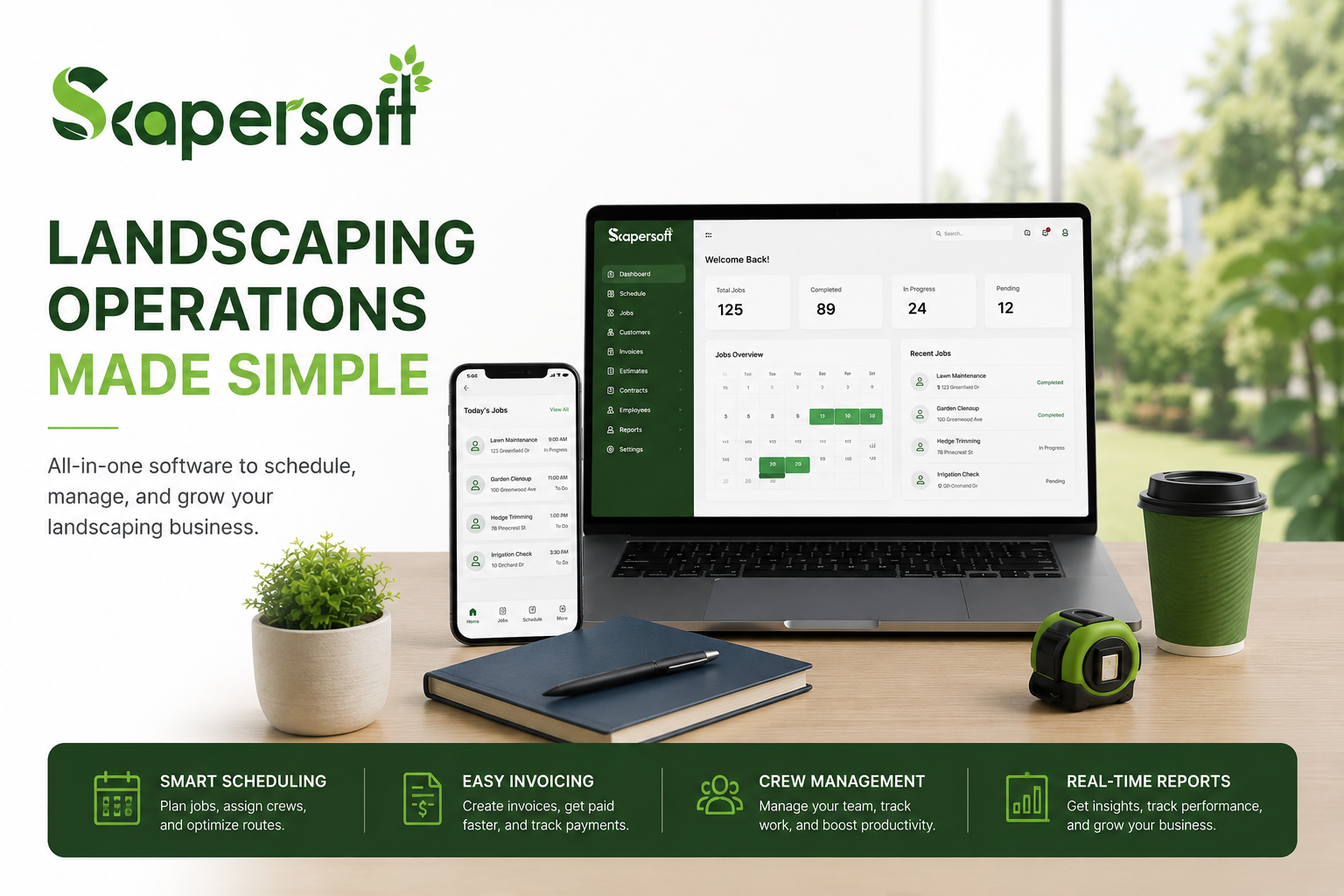
Modern landscaping software helps businesses bring scheduling, contracts, invoicing, customer management and field operations together in one place.
Contracts can be created with recurring visit schedules, while invoices are generated automatically based on completed work. Payments sync directly with billing records, reducing manual reconciliation and improving cash flow visibility.
Field crews can update job statuses, upload site photos and capture customer signatures directly from a mobile app-without needing to call the office for updates.
Built-in weather insights and route planning help teams make better scheduling decisions based on real-time conditions.
Customer records, contracts, invoices and site visits are all managed from a single dashboard, giving teams complete visibility across daily operations.
Final Thoughts
The landscaping companies struggling in 2026 usually aren’t losing because of the quality of their work.
They’re losing time to everything surrounding the work-scheduling, invoicing, paperwork, customer follow-ups and manual administration.
The companies moving ahead have stopped treating administrative work as something they simply manage and started treating it as something they optimize.
Today, customers don’t judge a business only by the quality of the lawn.
They also judge how easy it is to schedule a service, how quickly invoices arrive and how smoothly the overall experience feels.
In 2026, operational efficiency isn’t just an advantage.
It’s a competitive necessity.
Landscaping Software FAQs
Why are manual processes no longer enough for landscaping businesses?
As landscaping businesses grow, manual processes become harder to manage. Scheduling crews, tracking contracts, creating invoices and coordinating field teams across multiple locations can quickly become time-consuming and lead to costly mistakes.
How can landscaping software improve daily operations?
Landscaping software brings scheduling, customer management, invoicing, contracts and field operations into one platform. This helps reduce paperwork, improve team coordination and give business owners better visibility into their operations.
What are the biggest challenges of managing multiple landscaping crews?
Common challenges include scheduling conflicts, delayed invoices, missed contract renewals, poor communication and limited visibility into field activities. These issues often increase as the business expands.
Is landscaping software suitable for small businesses?
Yes. Even small landscaping companies can benefit from using software. It helps organize daily tasks, improve customer service and creates a scalable foundation as the business grows.
Why is operational efficiency important for landscaping companies in 2026?
Customer expectations continue to rise and businesses need to respond faster while maintaining accurate scheduling, invoicing and communication. Efficient operations help improve customer satisfaction, reduce administrative work and support long-term business growth.
Ready to Modernize Your Landscaping Business?
Managing a growing landscaping business doesn’t have to rely on spreadsheets, paperwork and endless phone calls. With the right software, you can simplify scheduling, streamline invoicing, manage contracts, coordinate field crews and keep your entire operation running smoothly from one platform.