
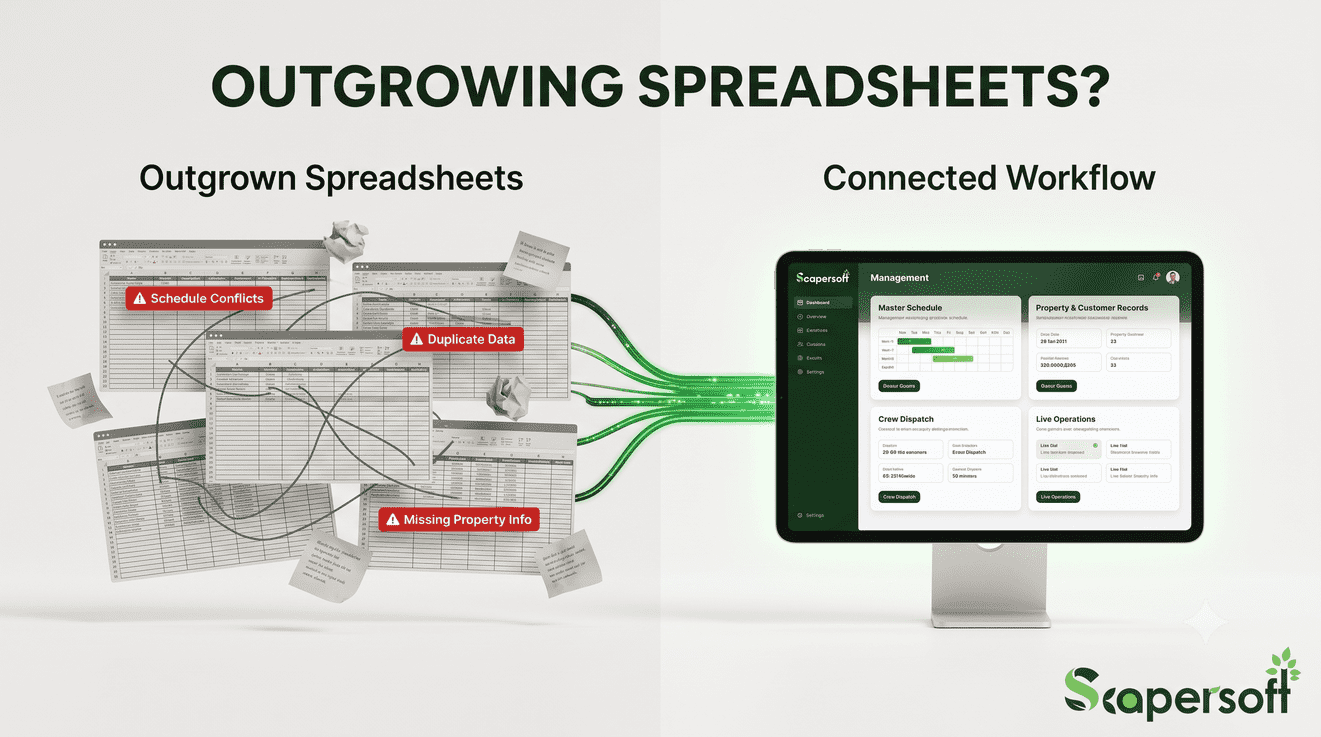
5 Signs Your Landscaping Business Has Outgrown Spreadsheets
Spreadsheets can be useful when a landscaping business is small. They can help you keep track of customers, properties, jobs, schedules, and other business information.
But as your business grows, managing everything through spreadsheets can become difficult. More customers mean more properties. More properties mean more site visits and job details. More employees mean more coordination. Eventually, keeping information accurate and up to date can take more time than the work itself.
If your team is spending too much time updating spreadsheets, searching for information, or coordinating work manually, it may be a sign that your landscaping business has outgrown spreadsheets.
Here are five signs to look for.
1. Managing Your Schedule Takes Too Much Time
Landscaping schedules can change regularly. You may need to manage multiple properties, site visits, employees, resources, and changing job requirements.
With spreadsheets, making changes often means manually updating information and checking that everyone has the latest version.
As the number of jobs increases, it can become harder to quickly understand what needs to happen each day.
A more organized approach to site visits and scheduling can give managers a clearer view of upcoming work and help connect visits with the employees and resources needed to complete them.
2. Customer and Property Information Is Difficult to Find
A landscaping business manages more than customer names and contact details. Each property can have its own information, documents, notes, tasks, and service requirements.
When this information is stored across multiple spreadsheets or files, employees may have to search through different records before they can find what they need.
This becomes even more challenging when one customer has multiple properties.
Keeping customer and property information organized in one system can make it easier for office teams to access relevant information and maintain a clearer record of the work associated with each property.
3. Crew Coordination Is Becoming Complicated
As a landscaping company adds employees and takes on more work, coordinating field teams becomes more difficult.
Managers need to know which employees are working on which jobs, what resources are required, and what work needs to be completed at each property.
If this information is managed through spreadsheets, phone calls, messages, and separate notes, coordination can take unnecessary time.
Connecting workforce and resource information with site visits and job details can help create a clearer workflow between office operations and field work.
The goal is not simply to assign more work. It is to make sure employees have the information they need to complete the work efficiently.
4. You Are Entering the Same Information More Than Once
Repeated data entry is another common warning sign.
Customer information may be stored in one spreadsheet, property information in another, and contract or billing information somewhere else. Employees may then need to copy information between these records.
Every additional manual entry creates another opportunity for outdated or inconsistent information.
A connected system can bring important business information together. Customer and property records can be associated with contracts, site visits, employees, resources, documents, tasks, invoices, and other operational information.
This can reduce the amount of time employees spend moving information between separate records.
5. You Cannot Easily See What Is Happening Across the Business
Spreadsheets can contain a large amount of information, but that does not always make the information easy to understand.
As your landscaping business grows, you may need quick answers to questions such as:
- Which properties are currently being serviced?
- What site visits are coming up?
- Which employees or resources are assigned?
- Which contracts are active?
- What invoices are pending?
- What work has already been completed?
If answering these questions requires opening several spreadsheets or asking different employees for updates, your current process may be limiting visibility.
Reporting and centralized business information can give managers a clearer picture of operations and help them make decisions based on organized business data.
What Should You Do If You Have Outgrown Spreadsheets?
You do not need to replace every spreadsheet immediately.
Start by identifying the areas creating the most work.
If scheduling takes too long, look at how site visits are planned. If customer information is difficult to find, consider centralizing customer and property records. If crew coordination is becoming difficult, look at how employees and resources are connected to jobs.
The goal is to identify where disconnected processes are slowing down your team.
Once those problem areas are clear, a landscaping business management platform can provide a more connected way to organize daily operations.
Move From Spreadsheets to a More Connected Workflow
A growing landscaping business needs information to move between different parts of the operation.
Customer information can connect with properties. Properties can connect with site visits. Site visits can connect with employees and resources. Contracts, invoices, documents, and tasks can remain part of the same operational record.
This creates a workflow where teams spend less time searching through separate files and more time managing the work itself.
ScaperSoft provides tools for customer and property management, site visits, contracts and billing, workforce and resource allocation, documents, task management, and reporting.
For businesses that have reached the limits of spreadsheet-based management, moving toward a connected system can make daily operations easier to organize as the company grows.
Conclusion
Spreadsheets are not necessarily a problem for a small landscaping business. The problem begins when they can no longer keep up with the complexity of your operation.
If scheduling is taking too much time, customer and property information is scattered, crew coordination is becoming difficult, employees are repeatedly entering the same information, or management lacks a clear view of operations, it may be time to consider a more connected approach.
The right landscaping business management system should help bring the important parts of your operation together and give your team a clearer way to manage growing workloads.
Frequently Asked Questions
When should a landscaping business stop using spreadsheets?
There is no fixed business size at which spreadsheets stop being useful. If your team is spending too much time updating, searching, or maintaining spreadsheets, it may be time to consider a more connected system.
Can landscaping businesses still use spreadsheets?
Yes. Spreadsheets can still be useful for specific tasks. The challenge is relying on them as the main system for managing customers, properties, site visits, employees, resources, contracts, and billing.
What should landscaping business management software include?
Useful capabilities can include customer and property management, site visits, workforce and resource allocation, contracts and billing, task management, documents, and reporting.
How does centralized information help landscaping businesses?
Centralized information makes it easier for teams to access customer, property, site visit, contract, resource, and billing information without searching through multiple disconnected files.
Is landscaping business management software only for large companies?
No. Growing landscaping businesses can also benefit from a more organized system when spreadsheets and disconnected processes start creating additional administrative work.